
ROAL Motorsport in anger: a full weekend with the team
ROAL Motorsport has always been one of the top teams in the World Touring Car Championship. Managed by Roberto Ravaglia and Aldo Preo, the team has diversified its operations through the years, claiming titles in the Superstars Series as well as starring in the Italian GT Championship. TouringCarTimes followed the Italian team for a whole weekend in Porto, to try and understand – and explain – how a high-profile team works in a normal racing weekend.
ROAL Motorsport field two ex-factory BMWs in this year’s WTCC, with the #15 320 TC driven by three-time race winner and former Yokohama Trophy champion Tom Coronel and Hong Kong’s Darryl O’Young, a regular front-runner in the Yokohama Trophy and multiple international GT race winner.
What is almost incredible to watch at ROAL is how everyone is relaxed, and yet at the same time so professional. In some teams the tension and stresses of the weekend can result in a bad atmosphere in the garage, but this is not to be seen at ROAL. Despite the difficult conditions, with all the BMWs struggling against more developed cars, everyone is focussed and working hard, no matter if it’s for a tenth place or for a win.
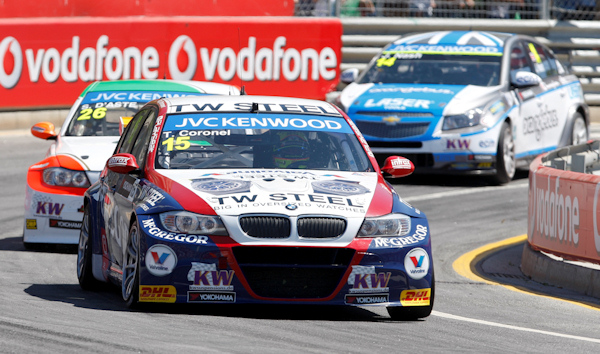
Pietro Speronello is the engineer in charge of the technical aspects of the 320 TC, as well the race engineer for Coronel’s car. O’Young is helped by his engineer Simon Cumberpatch, formerly Tom Chilton’s engineer at Arena Motorsport, and the two work together in all honesty and loyalty, which is not something you always get. There is a debriefing after each session, during which the engineers discuss the issues seen on track and the possible solutions.
The real work starts when the cars are in the garage after the sessions. As the debriefing takes place and the engineers decide in which direction to go in terms of set-up, the mechanics start working on the car to perform different checks. What happens in a team like ROAL, where the crew members know each other really well, is that everyone knows what to do straight away. Without a blink everyone takes care of a specific aspect of the car. ROAL have three people on each car in the WTCC, with one crew member’s job specifically to prepare tyres and fuel. Everything must fit in perfectly and, with such a “specialised” crew, it gets easier.
It is incredible to see how quick and yet accurate the checks can be. The car is lifted and there is a visual check for possible minor leaks underneath the car or any other kind of problem which may not have been noticed by the driver. The tyres from the session are removed and instead the so-called ‘set-up tyres’ are fitted. These are tyres that have never been used on track and are completely new. These allow the team to have perfect information on the status of the car, as the tyres used on track may have the odd marble on it.
Both drivers and the engineers work on the data acquired on track by the telemetry system; that is the first step to decide the changes to make. Coronel was quite happy with his car after practice, especially with slightly colder temperatures in the morning, so there was no major change on the car. O’Young was a little worried over traction, and that is the main point his crew worked on through the weekend.
As Coronel made it into Q2, O’Young missed the chance and was forced to stay in the garage. The Hong Kong driver did not look happy, but he was still following the second session very closely and with great attention from the pits, and so was a witness of the disaster that happened during qualifying for Tom Coronel. The Dutchman decided not to go out on track after Tuenti Racing Team’s Pepe Oriola’s accident had caused a red flag and, according to what the timing screen, meant that Tom had set the tenth fastest time and would get pole position for the reversed grid second race. Tom was on cloud nine because his gamble had paid off, but after some time, the timekeeper’s reported that there had been an error and Pepe Oriola was moved ahead of Coronel, which caused the BMW driver to start both races from eleventh on the grid. As a result of the situation, in particular because of the way the information had been received by the team, the Dutchman was very frustrated and appeared to miss the Sunday morning warm-up session in protest, though the official reason was to save tyres.
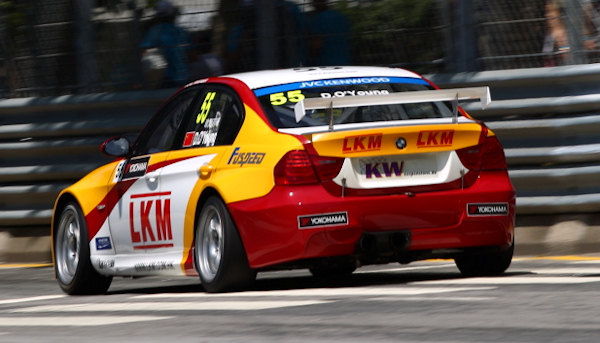
The effort the team puts in is huge. After qualifying both cars are practically rebuilt for the races. It’s understood that there is a team taking care of Tom’s car and another for Darryl’s, but the team works together if necessary. All the material which may wear out during the race is changed, not only the brakes, but also driveshafts and several other pieces of the car. The result of this effort is that the drivers can trust their cars, and they will be as quick as ever in the races. Old parts may result in failures or the car being generally a little slower, which is something that must not happen especially in a tight championship such as the WTCC.
Aldo Preo and Roberto Ravaglia share duties, as the former attends the World Touring Car Championship races and the latter follows the team’s GT project. Preo knows how to deal with the whole team, and he’s not one of those bosses who just watch the races trackside. You can often see him cooling down the turbo of one of the 320 TCs as well as helping out whenever he can. You can definitely see that he loves what he’s doing. This behaviour is particularly effective in a team that has been through so many years of racing, as it all feels like a family. We often hear those words from the drivers, stating that their team is like their second family. This happens with ROAL, as Coronel’s long stay in the team proves – this is the Dutchman’s third season with them. Aldo is also very keen on his personal fitness. One couldn’t tell how old he is, he is in a great shape. He was called a hero in the garage as he refused to eat a freezy in the heat of the Portuguese sun due to its sugar content.
There was a huge gap between Race 1 and Race 2, and the team really had some time to rest, because the cars are in Parc Fermé and cannot be touched. Some of the boys already started loading the trucks up with some of the equipment they would bring home, others were working on what had to be shipped to Argentina. After Race 1 the team cannot touch the car, but the engineer provides the mechanics some useful information as to what needs to be changed and how to fix the bodywork damage – which was luckily not much for both cars.
The lap out of the pits to go to the grid is not done with the tyres which will be used in the race. The four race tyres are normally kept in the tyre warmers at an undisclosed temperature, which is optimal to give the driver a good level of grip straight away. The BMW drivers have an advantage over the front-wheel drive cars on standing starts, and that is helped by a kind of handbrake device which can only be activated when the car is standing still and the driver is pushing the brake pedal. There’s a small lever next to the gearstick, the driver pulls it and the rear brakes stay activated. The driver can then leave the brake pedal and get ready for the start. This helps the car to be ready to fly off the grid spot as it is loaded with it at full power before it starts to move. Before the standing start, a piece of tape is applied to the pit wall, so the driver knows exactly where to stop on the grid. Even an inch is important at the start, as it can make a difference between gaining a place and losing it with such tight margins, and that is particularly true on a street track such as the Boavista circuit.
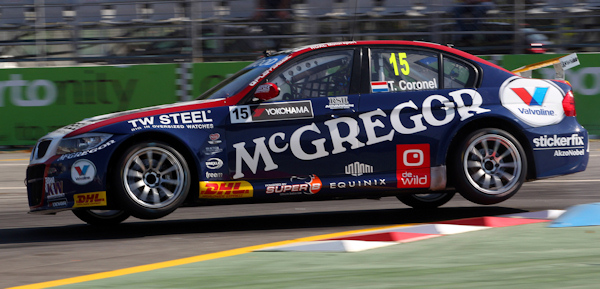
Before the race, Tom Coronel checked personally his rear wing. Ever since he joined the team he does that, helped by a mechanic, because he wants to make sure the level of downforce is to his liking. Rather than a technical operation, it looks more like a rite the Dutchman goes through every racing day. Coronel was quite upset on Sunday but he was able not to let his mood disrupt the crew’s morale.
Meanwhile Darryl O’Young was with his family, who had followed him to the race. The Hong Kong driver has a different style compared to Coronel when it comes to driving, he comes from a long history of front-wheel-driven cars in the WTCC and is therefore really focused on getting more traction, though he has plenty of rear-wheel drive experience in his other guise as a GT driver. O’Young is a polite person, a really nice guy and a team player. Despite him being not happy at not being able to fully exploit the potential of the 320 TC on that particular weekend, Darryl never let that be a problem when it came down to the relationship with the team. You could see he was willing to work, trying to find new solutions all the time and he was never to be seen “off duty”, he is very focussed and knows how to handle a difficult situation. He seems to have a very honest relationship with Tom Coronel.
There is a quite special moment for the two drivers after the races, once the racing weekend is over. They get into the truck together and tell each other the whole tale of their race. This glues them together and makes them a team within the team, they will have a laugh together and generally discuss the performance of the car, so they can come out with a second opinion from a driver who has the same equipment and team.
Despite pulling out great drives, both Tom and Darryl were not fully happy with the outcome of the weekend. Coronel was convinced – and there’s no reason not to believe him – that he could have won the second race, were it not for the timing glitch on Saturday. The Dutchman was able to keep behind him some really quick cars, and his experience could have allowed him to stick desperately on to the lead for a whole race. He was also quick to point out that the word “if” means nothing in the sport, and that he had to accept what happened and cherish the points he was able to bring home.
O’Young was not happy as well. He never really got to grips with the combination of the BMW 320 TC and the Portuguese street track. Nevertheless he was able to bring home some points in the Yokohama Trophy, which is always a good achievement, despite the problems he experienced all through the weekend.
All in all, the atmosphere at ROAL can be summarised by one of the crew members’ words I heard on Sunday: “When you’re on track life is not easy, it can get really tough to travel all around the world and work so hard to make things be perfect. On Sunday night you thank God it’s over because the adrenaline finally goes away, but on Monday morning you miss it and really want to go back out there racing.”
ROAL is a group of passionate and hard-working people, who almost always speak their own dialect to communicate with each other, who share a great passion for the sport. Being with them for a whole weekend, I realised that the strength they have is not just the technical, but it’s also about human qualities that shine through the difficult moments of the weekend.
Just ask Tom and Darryl!


