WTCC gets ready with new look 2011 season
The 2011 WTCC season starts this weekend at the Brazilian circuit of Curitiba. TouringCarTimes previews the 2011 championship, with a look at the first significant rules changes in the championship’s short history.
With an extended 12 date calendar with the addition of China this season, the WTCC continues to expand its global reach, whilst the level of competition is generally on a hold, with manufacturers holding back to commit to the series. In order to entice more, the WTCC has introduced some changes which it hopes will attract further competition especially from 2012.
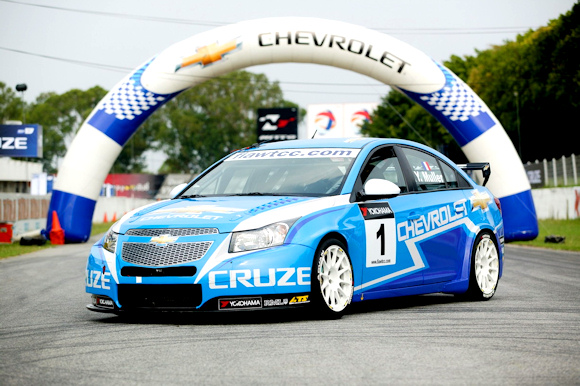
The biggest change being implemented for 2011 as a result is the switch to the 1.6 litre turbocharged ‘World’ engine, which has already been seen used in the first two rounds of the FIA World Rally Championship by Ford and Citroen. 2010 champions Chevrolet are ahead of the pack in terms of time with the engine, with the team testing since September last year. That advantage coupled with the fact that they are the only existing manufacturer supported team with an unchanged driver line-up makes them the obvious candidate for success in Curitiba, and for the 2011 season in general.
The Achilles’ heel for Chevrolet will be the additional torque of the turbocharged engine causing increased tyre degradation for their the front-wheel drive cars, a problem which won’t be so prevalent on the BMWs.
BMW have no works team this year, but that doesn’t mean there won’t be a few cars capable of challenging for race wins at least. The biggest threat from BMW is undoubtedly the ROAL Motorsport BMW, with Roberto Ravaglia’s team returning after one year away with a converted 320 TC for Tom Coronel. This marks the first time Coronel has driven rear-wheel drive in the series since, though Tom is still a regular rear-wheel drive racer with the Le Mans Series Spyker C8 so shouldn’t have any problems adapting quickly.
Coronel won’t be eligible for the independents’ trophy however, which promotes the top BMWs in that category to reigning champions Proteam Racing, who return without Sergio Hernández, but with former GP2 star Javier Villa and Mehdi Bennani, who had a troubled 2010 season with Wiechers-Sport despite an impressive 2009 debut with Exagon Engineering.
Liqui-Moly Team Engstler also has two capable drivers with 2010 independents’ runner-up Kristian Poulsen rejoining Franz Engstler at the German team. Other BMWs will follow, with reigning rookie challenge champion Norbert Michelisz joining the championship from round two in Belgium, and Urs Sonderegger with Wiechers-Sport.
The rest of the field effectively form the part of the grid that are waiting for more competitive machinery. SUNRED will again run six SEATs with TDI engines, but they’re unlikely to be competitive against the new 1.6 turbo petrol engines in the BMWs and Chevrolets. SEATs goal will be to pick up points and rest on the reliablity of the SEAT TDI package until they can introduce their own 1.6 turbo later in the year.
The same applies to Volvo, which enter the WTCC for their first full season and are the only other manufacturer backed team in the championship. The successful STCC team Polestar Racing will run one Volvo C30 built to national S2000 regulations for Robert Dahlgren, and are also developing their own 1.6 litre turbo for introduction later in the year.
A team with much less of a wait is Bamboo Engineering, who will start the year with the Chevrolet Lacetti they campaigned last year, but will upgrade to a pair of Chevrolet Cruzes with the new Global Racing Engine from RML from round two at Zolder. Drivers Darryl O’Young and Yukinori Taniguchi will therefore be aiming also to grab whatever points they can by just being at Curitiba, a opportunity which Wiechers-Sport’s Urs Sonderegger and Zengo Motorsport’s Norbert Michelisz will be missing out on.
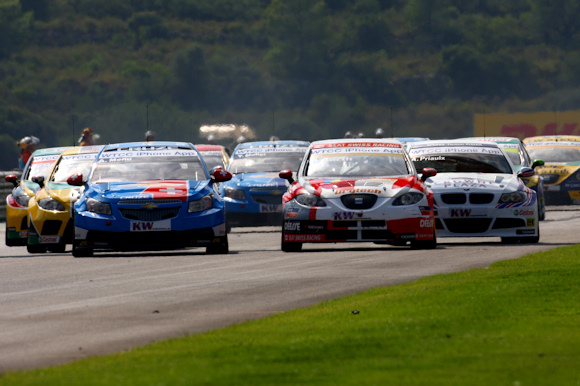
Although engines are the main talking point, there has been a sporting rule change as well in regards to the way the grid for race two is decided in 2011.
In order to prevent drivers from dropping places or hanging back at the outside of the top eight in race one, the reverse grid will now apply to the top ten placed cars from the first qualifying session.
How this will affect strategy in qualifying will be quite interesting, as it is now beneficial, albeit risky, for a driver to finish lower down in the top ten in the first qualifying session, and he can then go all out in Q2 for pole position for race one. This means the pole position driver for both races can theoretically be the same person, even after a driver wins in race one, meaning both races could be won by the same driver from pole position.
Also, if a driver suffers with a technical problem or damages his car in Q1 before setting a competitive time, that driver will be hampered throughout both races as the grid for positions 11+ will be identical in both races. Previously, the driver could at least work his way through the field in the first race to improve his starting position for race two. If he could also break into the top eight, he could even secure pole position for the second race.
The end result of this change will be a less random spread of points throughout the field – with points generally allocated throughout those with the capability of regularly qualifying in the top ten, which will certainly favour the turbocharged Chevrolets and BMWs early in the season.
The penalty weight system which caused such controversy last year still remains, but the direct causes of those issues are gone. There is no ‘old model’ BMW, all teams are running the same BMW package except Fabio Fabiani, who would barely benefit from a weight break considering he is running the 2.0 litre normally aspirated engine.
There are also no gearbox questions, with all of the new BMW 320 TC cars running with six-speed sequential gearboxes by default – a first for the WTCC BMW teams though BMW touring cars have been fitted with these in the British and Swedish championships for years.
Unfortunately, the main reason why there are unlikely to be any high profile squabbles between the manufacturers over the course of the 2011 season is because there is only one manufacturer competing for the title. Although Volvo is officially the second manufacturer, their campaign is a development exercise with one driver and an uncompetitive S2000 engine to start with.
With BMW’s withdrawal from all but a supplier position, similar to that of SEAT’s role last year and again for 2011, Chevrolet will battling between themselves with Rob Huff set to challenge Yvan Muller for the title. The independents’ battle is likely to be the closer fight to watch between the BMW teams and the Chevrolets of Bamboo Engineering.