Drivers confused by new qualifying system
Many of the WTCC’s drivers are still unsure what the objective of the new qualifying format is after the controversial format continues to produce very random grids for race two.
The two drivers who had pole position for each race at Monza are among those questioning what they believe is effectively a lottery for the race two grid.
Tiago Monteiro had set the fastest time in both of the Q1 sessions at Curitiba and Zolder, and as a result had drawn tenth on the grid for race two.
At Monza, the Portuguese driver was this time tenth fastest and so drew pole position for race two, with the top ten of the first qualifying session reversed for race two.
Despite obtaining the best position on the grid for race two, Monteiro was still not happy with the system.
“To be honest, it’s a lot of luck, that’s the problem with this qualifying. I wouldn’t call it qualifying, it’s a lottery, I’m not happy with it,” said Monteiro to TouringCarTimes.
“Okay I’m on pole, great, but it was pure luck.”
“I think I was a bit fast so I lifted off on the straight, but how much do you lift off? If I lifted off too much I was out of the top ten, just, and if I had not lifted off I’d have probably been P6 or P7.”
In the WTCC’s history, the grid has usually been decided by reversing the points scoring positions of the first race for race two (top eight), with the new qualifying system coming into force this year. Tiago offers his view on what improvements or changes could be made:
“There’s never a perfect situation, that’s clear. Whatever we change, some people will like it, some people won’t. To be honest, my guess is last year was not that bad, with a few tweaks.”
“I still think that maybe the second race shouldn’t score as many points at the first, GP2 does it. But something similar to last year, it was working quite well. I know the reason why, they were trying to avoid this drop down thing, but if the second race scores less points, there’s less of an incentive to do that.”
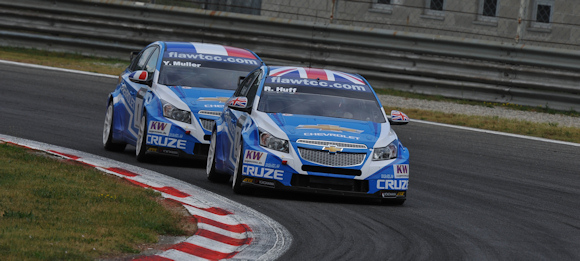
Chevrolet driver Rob Huff benefitted from the system, with the ninth fastest time in Q1 he would line-up on the front row for race two, and with the fastest time overall in Q2 he would have pole position for race one.
Those two very strong grid positions would gave Rob the opportunity to go on and take both race victories, but the British driver, although not as damning of the system, admits it appears a bit confusing.
“P9, very pleased. They are the words I never thought I’d ever say in motorsport. I don’t think anyone would be happy with a P9 but of course it means P2 in the real world,” said Huff.
“It is very strange to go out and not go as fast as you possibly can, but at the same time I think it’s great for the fans. I think it keeps Q1 very interesting, and everything’s constantly changing and it is a bit of a lottery.”
“From that side of things I can see the championship has done a good job in making these rules, but I’m not sure what the actual angle of it is. Is it to get the faster drivers starting eighth, ninth or tenth and towards the back-end of the top ten? And if they offered points for P1 in Q1, then that’s what they would have. I’m not convinced that’s what they’re trying to do, they’re just trying to shake it up a bit.”